Silver Linings Playbook was a film that when I first heard about I wasn't too sure I wanted to see. The name didn't really catch me, and I was feeling quite "down and out", not to mention cynical when I came upon the title. In a whim I chose to sit down and watch it based on the fact that Jennifer Lawrence won an Oscar for her performance and I just wanted to see what the heck all the fuss was about over the film. By the end of the film I was glad I did.
The film is about a man who suffers from bi-polar syndrome who is being released from a rehabilitation center after having an episode from coming home and seeing his ex-wife in the shower with another man. He's released on probation and goes about with the goal of trying to turn his life around to try and win back his ex-wife. He meets through friends Jennifer Lawrence's character who is a slightly depressed widow, and eventually after several seemingly "chance" meetings he decides to help her participate in a dance competition if she'll help him win back his ex-wife. I think you can tell the rest of the plot from there.
Philly, as in life, is a character all its own in the film.
Both Jennifer Lawrence and Bradley Cooper give stellar performances and deserve any and all accolades thrown their direction. The fact the film tries to tackle having a main character have a disease such as bi-polar syndrome is both a breath of fresh air and gives Cooper a chance to really flex his acting muscles. Robert DeNiro as Cooper's father is also amazing to see outside of his more recent typical roles as a more working class man. The personality of "Philly" is wonderfully captured in the film and overall it is just well made, and not to mention completely hilarious. On top of that the film is positively un-ironic in its message of pursuing "positivity" and "silver linings", which is quite an odd message considering our extremely cynical and snarky society at the moment. It's like Pollyanna woke up from a long nap and decided to turn our frowns upside down. Now that's not to say there aren't clouds to our silver linings, and our protagonists don't completely get a triumphant happy ending of being number one in the dance competition, they simply earn the score that'll win DeNiro the bet and win each other's hearts. It's a cautious optimism and one which is willing to settle for "not being the best" but simply "doing the best it can". Which I think speaks to how our society's mindset is evolving as we turn away from desiring being the sole super power into a nation more willing to accept being a great power amongst many other greats, as reflected in a microcosm here.
I'm crazy and you're crazy, but somehow we're less crazy together....
There are a few problems the film has--most of which center in its depiction of bi-polar syndrome. It's treated like it's a "minor hurdle" that is easily "cured" with the "power of love". There is only one example within the film of Cooper having an "episode" which occurs about half-way through the film, and then the second half drops any and all consequences living with such a syndrome might have. The reason why that complaint both holds water and doesn't at the same time is because the film is following a formula. Those familiar with my post on romantic comedies know that the formula for such a type of film is that "two sick people heal each other through love", and this film is absolutely no exception. So while I can definitely agree with the critique, I have to say that given the type of film that it is (a mix between a romantic comedy and a screwball comedy), that one should have expected such a "wiping the dust under the rug" treatment to occur at some point during the film, if only due to the nature of film expectations from audiences. It goes back to our love of "conventions" as mentioned in the satire post, that we're more willing to forgive something for lacking "realism" if it conforms to a convention than we are someone for breaking a convention in order to portray something more realistically.
You love her, right? If not you can say hello to my claws.
Silver Linings Playbook is at its heart a mixture between a screwball comedy and a romantic comedy. What are the differences between the two? While screwball comedy will get its own theory post later on, I'll say at this point not too much. In a romantic comedy typically the rest of the world is healthy (overall) except these two individuals--but in a screwball comedy the rest of the world is a little sick (not too much) as well as our two individuals and our individuals against all odds not only manage to heal themselves but their society in a small way as well. In a screwball comedy you're more likely to have a whole cast of eccentric and intriguing side-characters than you do in a romantic comedy proper where at most you'll have one or two eccentrics. The antics of the eccentrics are also likely to be much more zany, ridiculous, and over the top in a screwball comedy than they are in a romantic comedy. I'm reminded of the collapsing dinosaur skeleton or needing to sing "I can't give you anything but love" to a leopard inBringing Up Baby which is the quintessential screwball comedy. In What's Up Doc? the curse of bad luck that follows our female protagonist wherever she goes is another example of the complete ridiculousness of the genre. In a screwball comedy the world is completely ridiculous--but that's okay because some of that ridiculousness is seen as a little "healthy" to balance out an otherwise dry and boring life. Silver Linings Playbook doesn't go to the extremes of ridiculousness of other screwball comedies--and even tempers it, but you feel it wouldn't be completely out of character if it did. Only part of the society our characters lives in is full of wild eccentrics--their immediate neighborhood--everyone outside of the immediate neighborhood (as depicted at the dance competition or at the school Cooper used to work) is depicted as "normal and well-adjusted" and having to deal with the zaniness of our characters, and so that's why I say it's a mixture between a romantic comedy and screwball comedy: only a small part of society is crazy and needs healing--not the whole of it. Our protagonists compared to the zaniness of the small sick society they come from, become more well-adjusted, but they remain crazier than the rest of our normal society, finding a way to balance and live in between the two. This seems to be the new norm for our modern take on this romantic comedy/screwball comedy mixture if the films Post Grad, 500 Days of Summer, and The Holiday are anything to judge by.
With one shot, New Hollywood was born.
Sliver Linings Playbook isn't like most films Hollywood releases--scratch that--it isn't like most films it's released since 1967 when "New Hollywood" took over with its attention to violence, sex, special effects, and explosions--and began dominating the silver screen with the shockingly bloody ending to the film Bonnie and Clyde. Silver Linings Playbook as a film could've easily been made any time prior to 1967--but probably in the 1930s during the golden age of screwball comedies--as that is essentially what the film is. You could easily put Ginger Rodgers in for Jennifer Lawrence, and a Dick Powell or some other slightly gruff guy for Bradley Cooper. The only difference between the 1930s and now is that in the 1930s they would've ended up becoming superstar dancers and winning the dance competition in the end. Beyond that everything else is transferable and has its equivalence. Jennifer Lawrence can still be a young depressed widow who's had a few too many indiscretions which has caused her to lose her job and turn to dancing while living with her parents. Bradley Cooper's parents in this iteration would become owners of a boarding house that he's now living in. You can still keep the betting subplot that his father has--but change the sport to baseball and the bet is between him and the only boarder who pays his rent on time while everyone else is behind, with the bank on the parent's about possibly repossessing the house turned boarding house. Instead of running into each other while running, the change there would be that Bradley Cooper's 1930s character likes to walk the streets visiting places where his ex-wife and he used to be. Bradley Cooper's character would change from outright having bi-polar disorder to simply being a little depressed but now on the mends and trying to win back his ex-wife. They can still have their "meet cute" of he needs a wife and she needs a husband, she can still be quite sassy and street smart, he can still be naively optimistic and a bit of a dreamer. The final scene where Lawrence character is crying and Cooper's character rushes after her to tell her that he really loves her and he has for a while is only missing the swelling violins and taffeta to have been between Becall and Bogart or Garbo and Taylor. I could go on and on, but I'll stop there. This is not to say that Old Hollywood will return as it was--this new wave that's still working its identity out is a bit more gritty, ironic, and quirky and much less glamorous than Old Hollywood ever was, even with all the similarities I see. It's a modern take on Old Hollywood, bringing some things back from the grave, while updating other things that don't transfer so well to all the changes that have happened in the past forty plus years.
So why did I just spend a nice lengthy paragraph detailing how this film would've been made in the 1930s? Well, that's because not only could it have, I think it marks the beginning of the end of "New Hollywood". I know with all those superhero films coming out, it looks like New Hollywood is digging in, but at the same time there is a slow--but growing movement in younger film makers I've been noticing to tell simpler stories that are low budget (hence little to no special effects or explosions) and are now referencing sex and violence but we hardly see any of either on screen. Silver Linings Playbook is just near the forefront of this trend in film making. Arguably New Hollywood didn't take over in one year either. Guess Who's Coming to Dinner, Hello Dolly!, and What's Up Doc? which were all released after Bonnie and Clyde are very much of the Old Hollywood formula. Consider ourselves in the transition period. So this doesn't mean that expensive blockbusters with their pricey special effects are through--but it's getting towards the end.
Satire often in modern times is blended with its more low-brow brother farce and nowadays called parody. Sometimes we even go so far as to call satire "meta-humour". However satire is quite distinct itself as a genre and should be noted as such. While I am including it in the "What Makes Us Laugh" theoretical series, I'm doing so because it literally makes us laugh, not because it is a descendent of comedy--actually it's quite the reverse, comedy is a descendent of satire. In fact one could technically say that satire was the "original comedy" under Aristophanes and traditional Greek Old Comedy. In fact Aristophanes is dubbed, the "Father of Comedy", though I argue he really laid the foundation down for satire (and farce) first and foremost, and modern comedy comes from Menander.
I know what you're thinking...
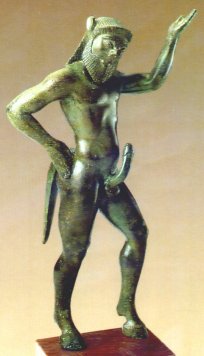
The history of Satire however begins earlier than that though. Where we get the word satire come from the old Greek satyr plays that would play immediately after a Greek tragedy trilogy. Although only one complete Satyr play survives entact to this day, we can derive from it, fragments of others, and descriptions of Satyr plays in general that they typically involved Silenus, the leader of the satyrs, and his flock of fellow satyrs getting into some kind of predicament and a hero character coming along and managing to rescue Silenus and his merry flock. More will be mentioned on this in the next theoretical post next Monday. In this early time I'd argue that satire and farce had not yet separated into separate genres and even in the poop joke loving Aristophanes the two forces still managed to be held in balance. What were these two forces you might ask? I'll give you one answer today and another next week when we look at farce in depth, when I hope to get a rise, out of you all. So, let's take a look at Aristophanes, shall we?
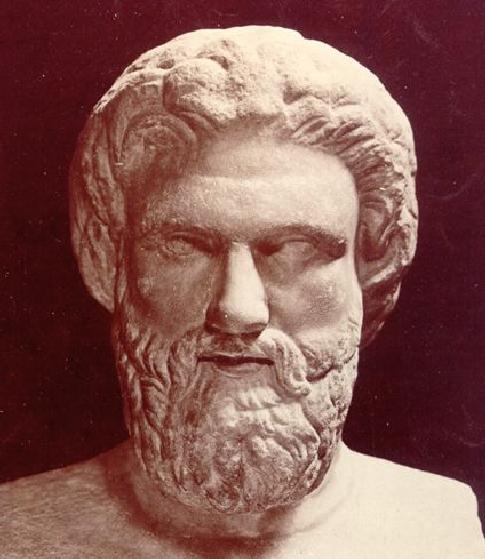
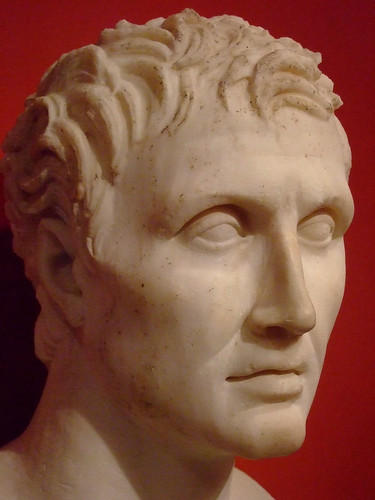
Stone cutters took pity and gave him a great head of hair.
Little is known of Aristophanes' own life. He was most likely only just eighteen when his first play The Banqueters was produced, and despite the picture of the marble bust depicting a full head of hair, it's thought that he probably was prematurely bald due to the number of self-deprecating jokes he made against himself in his plays. He wrote forty plays that we know of, eleven of which have survived to this day. We know from Plato as well as his own parabasis that he embarked upon becoming a comic dramatist because he didn't like the ridicule that comic dramatists received and wanted to create a better image for them--comedy at the time was the new kid on the block and had much the bad reputation. As such, while generally remembered by Plato to be genial and good-humoured, he's depicted as not liking to be belittled or dismissed. Aristophanes' comedies are what we today would clearly recognize as highly political satire. If Aristophanes were alive today he'd write and perform for the Capital Steps or Saturday Night Live quite easily--in that way you could say he was the Tina Fey of his day--although with his propensity for poop jokes, he might have fit in better with the bawdier Mad TV. As such, a lot of his humour was very politicized and topical to the times he lived in, and Aristophanes sure did live through some interesting times. Not only did he live through the dying days of the Peloponnesian War (which is quite clear in his play The Frogs--in which Dionysus goes to the underworld to hold a contest to bring back the best playwright to re-inspire a demoralized Athens with a great work of tragedy), but also two oligarchic revolutions, and two democratic restorations. He lived through troubled and interesting times indeed and through it all used comedy in the first satiric manner to parody and make fun of many well known figures of his day. We know from Aristophanes for example that for a fact Socrates existed and wasn't just some figment of Plato's imagination because Aristophanes parodies Socrates quite extensively in his play The Clouds.
Remember, this is funny to an audience
who has no doubt in their faith in Zeus.
He also took on figures such as Cleon (a prominent Athenian statesman and strategic mind during the Peloponnesian war--Aristophanes and Cleon got into a heated debate over how Aristophanes depicts him), Lamachus (a risk-taking general of the Peloponnesian war), to the gods themselves--Dionysus getting a rather hilarious portrait in The Frogs. And it's here where we first see the beginnings of satire. Satire isn't afraid to hit hard and hit high. Primarily it is on the attack. It's humour is based around attacking something--typically real-life people--and making a mockery out of them. Again, I say if Aristophanes were alive now, he'd write for the Capital Steps and he would've have had deja vu during the Iraqi War and it's similarities to the Peloponnesian war. Yes, I should note that Aristophanes was virulently anti-war, well anti-the Peloponnesian war, not so much against the concept of war per se. However while attack is an important part of satire it is not the end-all and be-all part of it. Otherwise pure invective or simple plain cursing and swearing at a person would be considered satire. No, there has to be something more to it, the attack has to be balanced with a sense of humour that way satire doesn't completely wallow in the sea of the mean-spirited.
Another tradition that comes from Aristophanes in to modern satire is the idea of authorial intent. In no other literary genre is authorial intent more out in the open and plainly obvious for everyone to see. Often times the author will speak to us through to work to the readers or audience directly, giving a little smirk, wink, or eyebrow raise for our own benefit. This was actually a formalized part of Old Comedy called the parabasis, and it is here that the author's intent was made clear to the audience, as the Greek chorus would "break the fourth wall" and speak the author's mind directly to the audience. Often times, well at least from Aristophanes' play, we'd get insights into the life of the author, but at the same time, the focus usually was more on the message that the author wanted us to take from the piece. It is from parabasis that the tradition of witty narrators, self-deprecating humour, and breaks in the fourth wall between the world of the story and our own as readers come from. Often satires will play with the notion of characters being self-aware that they're in a story, or will play around with self-awareness in general. As such the satirist will play around with exploring the artificial nature of storytelling.
Cracked.com plays around with the notion of self-awareness
Although comedy derived from satire, I'd argue they've evolved to the point where neither truly exists in the same world, and the only thing similar about them anymore is that they both make us laugh. True comedy as we know it today is about community building, and satire if anything is about community destroying. Satire
sees the world as corrupted and in need of a good purge--and it sees itself as the man up to the task to point the rest of us in the right direction. In a lot of ways satire is about wading through the muddy, dirty and disgusting parts of society that would trouble or upset us in a comedy. Comedy would try and laugh it all off as us just "being human", but satire likes to sit with the uncomfortable and demands that you pay attention. Satire typically wants to change the world, probably just as much as some of the best melodrama does. Except satire will try and get to you through your mind and intellect, while melodrama will hit you in an emotional gut wrenching manner.
I hope it's not the swimsuit edition.
As satire likes to focus in on the corrupted part of society, it could thus be said to be about giant slaying as Northrop Frye argues in his essay on the genre. I know, that association probably threw you for a loop, but please hang on for a second. Usually it isn't the giants of romance (although in some special cases it literally is), no it is the self-important fools who think themselves great and grand--like politicians, the clergy, professionals, and other people of "high respect and esteem". The "giants" of their fields, so to speak. This goes back to Aristophanes and his love of taking real life people he knew down a peg or ten. Usually in doing so satire could be said in Frye's terms to be taking an alazon and attempting to reveal that the delusion they have does not reflect any apparent sense of reality. However, as is often the case in satire, the entire world is full of alazons. Satire thus could be said to also concern itself with distinguishing reality from illusion, as well as the theme of deception. A lot of time is spent in satire in distilling "reality" and knocking people into seeing the "world as it is". Realism's existence is thanks in part to satire as well as science.
After Aristophanes' Greek Old Comedy gave way to Menander's Greek New Comedy, the notions of satire weren't again picked up until the early days of the Roman Empire under the quills of Juvenal and Horace. Here is a quote from Horace's The Art of Poetry, which discusses a new idea to crop up in our development of satire, humour of convention:
"Gods should not talk like heroes, nor again
Drink Roman, the only wine that matters.
Impetuous youth like grave and reverend men; Lady and nurse a different language crave, Sons of the soil and rovers o'er the wave; Assyrian, Colchian, Theban, Argive, each Has his own style, his proper cast of speech. In painting characters, follow tradition, Or in inventing be consistent, If great Achilles figure in the scene, Make him impatient, fiery, ruthless, keen; All laws, all covenants let him still disown, And test his quarrel by the sword alone. Make Medea all revenge and scorn, Ino still sad, Ixion still forsworn, Io, a wanderer still, Orestes still forlorn. If you would be original, and seek To frame some character ne'er seen in Greek, See it be wrought on one consistent plan, And end the same creation it began." -- Horace
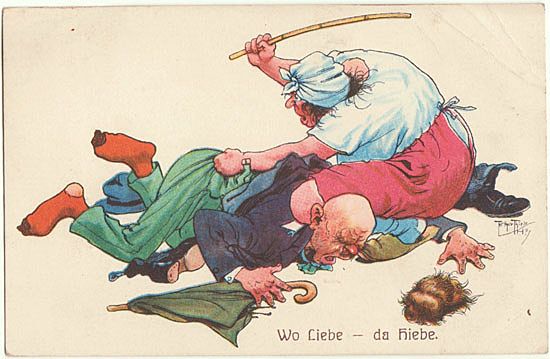
In this short excerpt from Horace, he argues for convention and tradition in character creation, he goes on to argue that it's hard to put an original twist on a story men know so well, but he asks us to maintain conventions for the sake of not confusing one's audience. And the reason I quote this is because Satire is a form of humour extremely dependent on convention. An example given by Northrop Frye that will be mentioned later as well, is the convention of the battered husband and shrewish wife. We conventionally find it funny in a comic strip for a wife to beat her husband with a rolling pin or a frying pan of some sort, but to introduce a comic strip where a husband beats his wife would stop and confuse its readers. One thing we know from convention is funny, the other we're told is a more tragic situation, and so an uneasy feeling would settle on the readers which would kill the satiric mood. Satire does aim to make its audience uncomfortable, but this specific level of discomfort is how one loses readers and audiences. It's a line not to be crossed too often, and when you do, as Horace suggests, be consistent.
=
One is cute in a weird way, the other has cute bu--
I think I know why we updated this convention...
Similarly if you wish to create a new convention, likewise be consistent. Arguably the minions from Despicable Me have created a new convention that has been emulated in many other children's films and will continue to be so in time to come. However I'd argue they're not so much a new convention as a re-imagining of an older convention of kewpie dolls and cute little cupids (see Disney's Fantasia). Conventions have lives and after living a full one, will die or fade from popularity, and as such every so often will be unexpectedly revitalized by a re-imagining of the convention in a manner that more modern audiences can relate to.
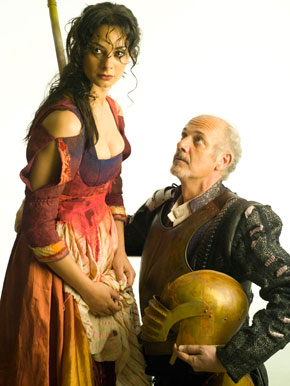
A knight and his washer lady.
So we've talked about attack and humour of convention, the two most vital parts of satire but in order to understand the final part of satire we need to jump ahead in time past the golden age of Romance in the Medieval period to the Renaissance where we arguably see the birth of modern satire with Don Quixote. To look at Don Quixote, one sees an obvious juxtaposition between itself and the Romances it parodies. Most heroes on a quest are young men, Don Quixote is at the senile end of his life. His lady love is a washer woman, the giants he faces are windmills. Don Quixote is an obvious satire of the Medieval Romances. Satire likes to concern itself with parodying Romance quests and epic journeys of sorts. And as such in a satire, episodic adventures, strange encounters, and odd intervals can be inserted for as long as the satirist desires. All of this comes from Don Quixote's influence as a cornerstone of modern literature. Due to this, satire often is seen as the complete opposite of romance. As such as romance was the elite's propaganda, satire can be viewed as the common man's response. In fact the most noted of satirists always seem to to be self-made men from the lower classes or are considered "outsiders" from a lesser ethnicity or nationality, from the lower class Horace to the Irish Jonathan Swift.
Gulliver in Brobdignab where the tables are turned.
Speaking of Jonathan Swift, he adds another element to Satire through Gulliver's Travels, which is a humour based on the fantastic or exaggerated. It's a grotesque based humour, made obvious blatantly obvious by the exaggerated extremes our character is taken to. These exaggerated extremes though never get balanced out for the reader like they would in a comedy, so they remain in their "sick" extremes. The little people of Lilliput will constantly be a war with the Bigenders over petty small individual quarrels like which end of an egg to break first. The giants of Brobdignab might have a better concern for its community at large, but it will overlook and suppress the individuals within its community. Brobdignab may also be free of war, corrupt officials, and greed--but at the same time it doesn't have music, art or modern science. Laputa may finally think of the meaning of the universe, but they'll never appreciate the beauty of a flower. The Academy might go about creating a new perfect world, but they'll have utterly destroyed the old one, and so on and so forth. In fact that's probably the best way to look at satire. Our protagonist has become stuck in a world full of the sick and insane, and in the darkest of satires, the person stuck there doesn't even realize that they too are sick and insane as well.
In Wonderland, everyone's mad. I'm mad, he's mad, you're mad...
The best case example of a satirical "protagonist" getting stuck in a "world of crazy" would probably have to be the two Alice stories: Alice in Wonderland, and its sequel Through the Looking Glass. Through those two novels, and Charles Kingsley's The Water Babies (which satirically makes fun of fairy tales), satire arguably entered the realm of
Children's Literature, and as such those novels can be reread as an adult and
appreciated on an entirely different level. There are many conventions
of satire to be found in Wonderland alone. The most obvious being that of the
battered King of Hearts and the overbearing Queen of Hearts--a satirical
glance at the balance of power between Queen Victoria and her husband
Prince Albert. The other is that the entire world of Wonderland is a
world full of loveable eccentrics taken to the extreme of their
characters. And all through it, our protagonist Alice makes it through as our lone character of "sanity" in an insane world.
Humour in satire, thanks to Aristophanes, can be more than just conventional,fantastical, grotesque, or poking fun at romance, it usually is quite topical as well. This is why of all the genres, I'd say satire has the hardest time lasting very long, and has to be constantly re-invented. Aristophanes attacked real people he and the rest of Athens knew, Cervantes parodied romance novels and stories that all of Spain had grown up reading, and Swift attacked the hypocrisies of his own society mercilessly. In each case though they were dealing with a subject that their readers already came to the table knowing quite well--and if we wish to understand just as much as they did, we have to do our own "studying" of the materials. However I would argue that the best satires, while using topical humour manage to find a way to transcend the topicality either by having the insanity it explores be SO grotesque and extreme that it transcends its specific time (Gulliver's Travels and the Alice stories fit here) or by simultaneously telling its audience what to expect to happen by meta-theatrically having the protagonist "explain the rules". Don Quixote for example, when asked to pay for his inn bill, proclaims that no knight ever has a concern for money and they're provided hospitality without any expectation of repayment. In the modern horror film satire Scream, a character literally explains "the rules" of old horror films.
Satire served up with a healthy dose of beer and teen torture, please.
While satire is quite topical in its humour, and thus prone to making fun of particular individuals, one can find a few common characters that belong to it that have now become prolific favourites.
Some common characters of satire:
The Last Man of Common Sense
Wait till he pulls out his gun in five, four, three, tw--BANG!
This character is one--typically with rural associations--who "cuts through bull shit" like a knife, reducing things to simple common sense to be weighed and evaluated. The character, though having a long history of existence, has come to be adopted by Americans of the Appalachian persuasion as their go-to source for entertainment and emulation. As such we have the reason for why Larry the Cable Guy exists. Jethro Gibbs from NCIS is another example. For a more refined American variation, see the suburban Mid-West's version with the Nostalgia Critic (as pictured), and for an even more refined variation, the Northeastern urbane Nostalgia Chick. The more urbane a culture this character comes from the more refined this type of character will become. I must say though that this is clearly the typical satiric character of choice for most Americans--whether they be rural or urbane, which as a nation suggests a more rural-based culture than most developed nations. Their sense of humour comes from wading through the excess wasteland that they see themselves in, and tearing it to shreds thus reducing it to its simplest elements to properly beat or kick to death. There is often something very violent about this character, for they usually see violence as the only way to "knock any kind of sense" into the world. Typically they see themselves as one of the last survivors of good common sense in a world run mad with idiocy. They only have common sense though in the lightest of satires. The darker a satire gets, the more common sense will be doubted as having any meaning and the crazier this individual will become until there's no distinguishing him or her from the rest of the insane society. In the darkest of satires, this individual is also an alazon figure who's worst offence is thinking he can save a society destined to go to hell in a hand basket by beating it into submission.
The Loveable Eccentric
Everyone loves Abby, that could be a sitcom, right?
Typically this character is female, but not always. There is usually something "off beat" or "quirky" about this type of character. And we tend to love them as there's some sense of "childishness" that lingers about them, but doesn't completely hamper them from interacting with the rest of the world in an adult manner. The satire of these types tends to stem from the fact that such a character of such professional knowledge or power can be so childishly eccentric. They add a diversity to the world they inhabit, breaking minor rules or conventions of that society that don't really matter, and by doing so allow us to discern the bull shit rules that need to be broken, and the common sense rules that need to be enforced. They're a living oxymoron that we love to see. These character types can only exist in the realm of satire where common sense can still be used as a measure of sanity. Once common sense is doubted these loveable eccentrics begin to disappear, and in the darkest of satires there's nothing at all loveable about them. While there are many examples of this type of character, arguably the best well-known one currently is Abby from NCIS, as pictured above who is a goth girl forensic scientist with a personality so sweet and loving she's the fan favourite of the show. See also Luna Lovegood from the Harry Potter series. For a more classic example see Betsy Trotwood from David Copperfield.
The Delusional Giant
Well isn't this rather obvious...
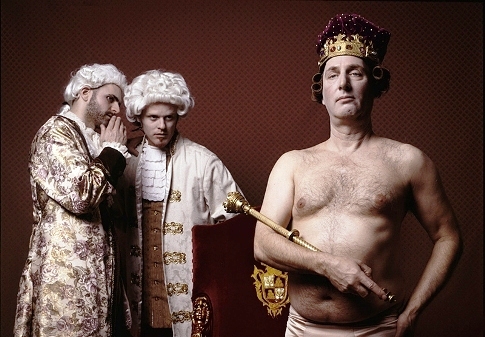
As mentioned earlier this kind of character is an Alazon figure who unlike the Alazons of comedy isn't self-deceived so much as they have an agenda to deceive the rest of society into thinking that they're greater than they really are. This is the classic "Emperor's New Clothes" situation, but usually with a darker twist that the Emperor knows he doesn't have any clothes on, but wants to make everyone else think he does. There are usually many delusional giants in a satire and they are often to be found in the highest positions of power and prominence.
The Battered Husband & Shrewish Wife
Feminists, if you want to change society, get rid of this... OW! Yes, mistress...
This type of character is a duo where you don't see one without the other. It's essentially a Punch and Judy show, except Punch has no recourse to a more dominating Judy. This is a traditional satiric take on "traditional marriages" where the inherent laughter comes from a man being so frying pan and rolling pin beaten he is unable to assert his societally expected male dominance over the women in his life. In modern times one can see something of its existence still in comic strips like Hagar the Horrible or in the related descendent of the Overbearing Mother and Momma's Boy pairing.
Now all that is fine and dandy, but how does it all interact with our society? Well, currently since about WWI or so we've been living in a "golden age" of Satire, where everything is smeared with a satiric touch from pornography to children's literature. Sure, in the 1950s and on into the 1960s there was a bit of a backlash to that mindset (thanks to Disney and the dewy-eyed Silent Generation), but come the 1970s our satirical outlook was more firmly fixed than ever--one eyebrow raise at a time. Satire was and always will be a genre about mercilessly attacking a sick society and tearing it down. By doing so the satirists attempt to show what is wrong with "us" so that we as an audience might know what to change. In a way it's like House (people still watch that show, right?), where the satirist is an expert at diagnosing the sick. Now as has been mentioned previously, although satire is brilliant at diagnosing the sick, that's just about all it does. It doesn't try to heal the sick like a comedy would, instead it's the little kid in the parade pointing out the Emperor has no clothes on, and it's never seen or heard from again. Satire gives us the diagnosis, but it leaves the cure up to us--typically Satire is too cynical and too suspicious of cure-alls and those who proclaim to have the answer to everything, which is probably why it doesn't bother trying to heal society. The satirist figures letting you know what the problem is is enough, and oh, by the way, you're welcome. You'll have to figure out the rest from here on out, the satirist's job is done. And that's just in the lightest of satires, in the darkest of the dark satires--there's just pure nihilism with absolutely no hope of reforming anything and so we all might as well enjoy the ride to hell while it lasts.
Satire as a genre is how we attack parts of our society which are seen as sick and are most likely incurable. Sometimes through common sense we hope to violently purge the idiots who now control our society, and in other cases merely thinking you can cure it at all is a ridiculous notion to hold on to. Which makes me wonder if the darker satires really don't have a point? Perhaps we as a society are sick and going to hell in hand basket and there's nothing we can do about it. And if that's the destination, at least we can laugh about it on the way there.
In our average day-to-day literary, stage, and film lives the term comedy gets thrown around a lot by Hollywood, authors, readers, actors, critics,
and audiences. But what does it really mean? Is its indifferent usage truly suggest a broad category? Or are there many subcategories contained with in? Are they truly subcategories, or are they themselves different? Can they be
separated, and if so, what's the history behind their development? And
most importantly, where can we see examples in our day to day literary
lives?
Happy or Sad, choose one.
To begin with, we have to explore the roots of the
system our society has come up with for separating our entertainment.
From small children, we're told simplistically that "comedies are funny"
and "tragedies are sad"--I think I remember that explanation
specifically from an old Walt Disney animated short from the 1940s or
1950s. But is that truly the root of the dichotomy? Let's start first
with Comedy, as that seems to be the progenitor from which all "funny"
drama seems to derive--one would think.
Comedy, as it
is popularly understood, is the genre that makes us laugh, and then has a
bunch of "sub-genres" contained within it--or so we think--depending
upon the type of humour that makes us laugh. The word humour should give
us pause, because it's an important one for the time when our modern version of Comedy was being formulated in the
Renaissance, Baroque, and Neoclassical periods. Why do I say it's
important? Because the modern association of the word with "something or
someone who is funny" isn't the first thing listed if you bother to
look it up in the dictionary. In Merriam-Webster it isn't listed until
the third definition, and our sense that it's associated with comedy
doesn't come in until "part c" of that definition. What comes before it?
Well, the short and simple answer is that both definitions prior to
that have to deal with the medieval (and ancient) belief in the "four
humours".
The weird symbols are Zodiac Signs.
The four humours being four bodily fluids (or
humours) associated with the more recognizable four elements (Fire,
Earth, Air, & Water). The four humours themselves were Blood (Air),
Yellow Bile (Fire), Black Bile (Earth), and Phlegm (Water). To further
shorten the explanation, a person had to try and keep these four humours
in balance with one another in order to remain healthy. An excess of
one bile or another would, in this world view, cause a person to become
sick and act in a manner that was contrary to their true nature. If you
had an excess of blood you were of a Sanguine nature (impulsive,
charismatic, optimistic, shameless, lazy, and boisterous). If
you had an excess of yellow bile you were of a Choleric nature
(aggressive, passionate, tyrannical, energetic, bossy, and strategical).
If you had an excess of black bile you were of a Melancholic nature
(considerate, cautious, thoughtful, perfectionist, sensitive, and
depressive). And if you had an excess of phlegm you were of a Phlegmatic
nature (friendly, consistent, affectionate, diplomatic, shy, fearful of
change, and passive-aggressive).
Now how did this word
humour get associated with comedy? Well, truly, old-fashioned comedy
I'd propose is about these four extremes coming together and driving
each other batshit crazy until they balance each other out at the end of
the story. Typically one type of humour has "gotten out of control" to
the point where the opposite kind of character has to come in and subdue
and heal the sick person. Essentially I'd argue
that comedy is in its modern origins about the sick becoming healthy and
the story surrounding that process is "funny" to us because the people
are so extreme that we find them to be "ludicrous or absolutely
incongruous". In modern comedy notice how it always plays to the extremities in its characters, plots, and paces. Up until the Age of Enlightenment (hell even during it),
Western
Civilization had this common acceptance of four humours that
had to be treated medically in order for "balance" to be achieved.
Health is associated with balance and sickness is associated with
extremity (you can still see that connotation today in politics when
politicians label their opponents as extremists). And sickness is
something we've found inherently funny. Yes, when we are laughing in
comedy we are usually laughing at sick people.
Hint: Rom Coms will be reviewed.
Before anyone goes into a
long rant about how horrible it is to be laughing at sick people, I ask
you do you really think much has changed since then? Do we find a person
with OCD who has to methodically have everything on their desk at right
angles with one another sad or funny? Well, judging by our modern
tropes and types, I'd say more typically we find it absolutely
hilarious. Why else would the strong independent business-woman type
with OCD marry the lazy dependant rebel-without-a-cause man type with
Peter Pan syndrome? Both are seen as "sick-men of society" who have
within themselves the capabilities of balancing each other out into
"normal healthy human beings" when paired together in a romantic comedy.
So this notion of sickness and health dominating comedy is not
something we've disregarded--we simply have forgotten its origin. Its
legacy though clearly remains with us.
All right,
now that we know generally that we laugh at sick people who are destined
to become healthy again by the end of the story, how is that employed
in a comedy?
Menander in his stone glory.
The comedic formulae we are most familiar with
derives first and foremost from the ancient Greek playwright Menander.
He wrote a bunch of plays in the style which academics have labelled "New Comedy". The reason he is considered one of the most
influential comic writers comes from the fact that Roman playwrights
copied his works, Renaissance playwrights copied the Roman
playwrights, and since the Renaissance we've been using the Renaissance playwrights as
the basis for the rest of comedy. Menander isn't considered the "Father
of Comedy"--Aristophanes is--but we'll talk about that guy in a later
post. However, Menander was arguably more influential in what became standard
comedic tropes and the basic formula for what we consider comedy today,
and as such, let's look at the basics within New Comedy.
Each door says something about their owner, don't they?
In New Comedy
you have on the stage "three doorways" as your basic background--out of
which characters will enter and exit for the majority of the
performance. Each doorway represents one place. For example in Dyskolos
(aka The Grouch), the three doors are two houses with the shrine to the
minor god Pan in the middle. What you make the three doors doesn't
matter so much (they can be three houses on a street next to each other
for example) but that's the set. Generally one person is dominating the
neighbourhood and imposing his will onto the surrounding area like a
little dictator--only his will is irrational since he's sick by being an extreme personality. Typically
you find in comedy some sort of irrational law that has been forced onto
the society of the play by this character. The society of the play can
be an entire nation or a family and its surrounding neighbours, but
somehow, some sick man (or woman) has forced himself to become the irrational
leader of this land, and is enforcing his will on others. The next
important element is typically a young character who has recently come
into the neighbourhood or is returning after having taken his leave from
the area for some time. This "new" element, inspires hope amongst the
community and eventually will be the "new leader" of the community, as
well as the element that will subdue and heal the sick man who imposes his will on others. This division of characters is called by literary critic Northrop Frye the difference between Alazons and Eirons.
Oh I just can't wait to be king!
Alazon
is the term for our "sick man" humour. Typically these characters are
imposters of sorts--what you see is not who they truly are. Typically alazons suffer from delusions of grandeur, thinking they're greater than they are. Having an
overinflated sense of ego like the Miles Gloriosos (aka the braggart) or
is an overinflated heavy father figure which is called the Senex Iratus
(aka the angry father), the point is, how they're acting is misguided
and they are guilty of the crime of having too much presumption and ego,
and need knocking down a peg or too.
There's more to me than first appears.
Eiron is the term for our
healing youthful character. Typically these characters don disguises to
make themselves to appear lesser than they actually are to counteract
the alazons and undo their presumption. Your typical diamond in the rough kind of characters. And usually through this act of
disguising only to reveal themselves truly this prompts within the audience the feeling
of "ascension" that a character has risen from a lower status to a
higher. Sometimes it might even be a smaller side character who's
unknown parentage is revealed to be the long lost Duke of some Duchy. In
which case the person's low status was a disguise which hid away their
noble blood. From this sense of ascension we get the Cinderella
archetype that persists throughout comedies, and another notable variant
would be the slave who rises after having broken free their chains.
Cinderella, a staple archetype of most comedies about hidden worth being greater than obvious worth.
Hard to believe it's the same guy, huh?
From
this one can guess that a big theme of comedy is the theme of identity.
Characters are constantly shifting their identities, hiding their true
identities, or thinking their identities are greater than they are, etc. This is so frequently touched on in comedy, that one might say that the "clothes make the man".
The final act is the removal of these masks and the revelation of the
people as they truly are. Similarly, to extend our allegory to comedy as
a parable of sickness, this correlates to how a person's sickness is
not their "natural state" of being, and the goal is to remove this
imposing condition of sickness and bring back the healthy person that
they truly are. As such, look to comedies to tell what a society
considers to be "fake", "posturing", and "sick" about our society.
They'll make us laugh for a while at these things and while doing so
prescribe what it believes to be the cure to these sicknesses. Typically
it'll be a marriage of opposites so that the two will "balance" each
other out until health is restored. In a Comedy there'll be healing
because ultimately it has a positive outlook on life, people, and
communities. Sure, we might get sick from time to time, but we can heal
and move forward.
I wonder how many pictures were discarded to get this particular one?
Ultimately comedy has, you could say,
a very "hippie" kind of outlook on life. And by that I mean that comedies are communal in nature, concern themselves solely with "life on
Earth", and celebrate all aspects of our humanity. Comedies concern
themselves with life of the simple average everyday people that make up a
community, and how each is vital to preserving life within it.
Typically you'll find beyond the main hero in our story a flurry of
other colourful characters who will all be partnered up. The reason
every character is partnered up with someone is because that is the way
to ensure life in the community--through marriage, which will generate
children, which will go on to continue the community once our characters
are dead and gone. This is one of many reasons most comedies end in a
marriage or the promise of marriage--because what other ceremony in life
better celebrates the idea of "continuation of life on earth" than a
wedding? What ceremony better celebrates the youth having grown up and
joining a community than a wedding? And what other way can the community
celebrate the newly initiated than through the communal group dancing
that is all too common at weddings? As for being celebratory of our
humanity, comedy is completely accepting of all aspects of being human.
Isn't it great that we have faults, that we have a body that grows
tired, needs to eat, sleep, and drink? Comedy is aware of the body and
isn't afraid to employ it for a little body humour as well. It isn't ashamed
of the body or think it a prison for a person like tragedy often tends
to do. Instead it revels in the fact that we are human because it feels
we find strength in being human and accepting our limitations. That's why slapstick is part of comedy,
because while someone is on the receiving end of all those punches,
throws, kicks, and pies to the face, it is usually people who aren't
comfortable in their own bodies--thinking they're grander than they
really are--and need a friendly kick in the pants as a reminder that
they too are mere mortals. How is all that "hippie"? Well, I mean
"hippie" in the idealistic sense of the ones who went out and formed
communes (communities) focused around a more rural way of life
(earth-focused) and were completely comfortable just being human beings
with little pretensions otherwise. I don't mean the radical protest
hippies, but instead the quiet ones who lived their ideals, not preached
them. You'd find the same kind of lifestyle in a community of farmers,
for those uncomfortable with the "hippie" label. Comedy thus is best
when it has some connection with the earth, and although it can exist in
a city, when it does it's usually a political or cultural capital city
from which changes will spread and be felt across the whole of the
nation.
Ultimately, comedy is about what society considers to be a healthy life, first and foremost, a celebration of simply being human, and isn't that great?
I think I'll make this kind of post a weekly ordeal as this technically took two days to write and post. So expect approximately every Monday a post about genre or the theoretical side of entertainment. In between times I might throw in a small review of a film, book or play I happen to read.
Next Theoretical Post:5/13/13 - What Makes Us Cry -- Part One: Tragedy, with Fear and Pity Next Serial Post: 5/20/13 - What Makes Us Laugh -- Part Two: Romantic Comedies, when Opposites Attract